
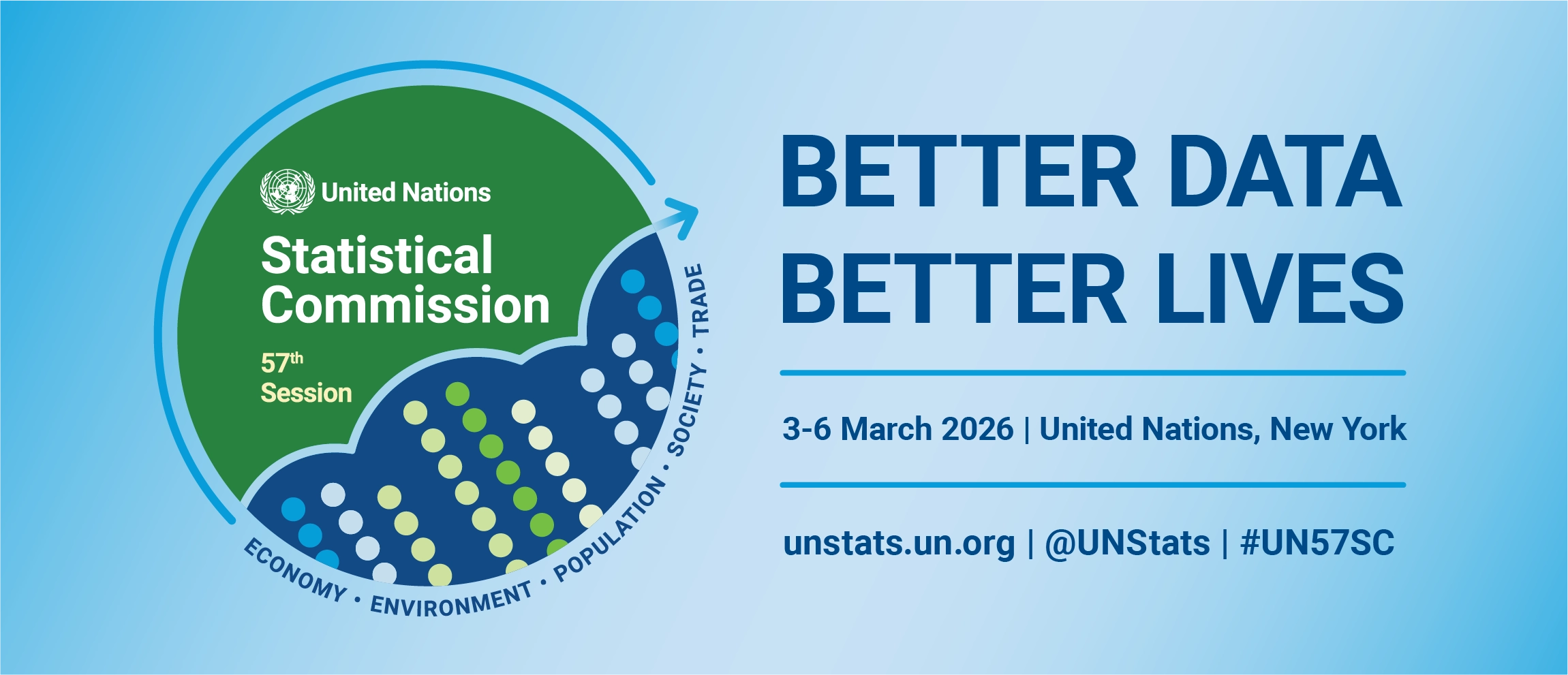
The 57th session of the United Nations Statistical Commission will be held in New York from 3 to 6 March 2026. UN Women will be well-positioned to ensure strong representation of gender statistics across the programme of work of the Commission, through a number of strategic interventions, including on time use, violence against women and girls, and women's statistical leadership.
Just launched
Time use and social inequality: a gendered perspective
2 Mar | 1:15 – 2:45 pm (EST)
Measuring the gender-related killing of women and girls: guidance for implementation and adaptation-the digital environment
Concept note | Flyer | Register | Livestream
The Statistical Framework for Measuring the Gender-Related Killing of Women and Girls was produced by UNODC and UN Women in 2021, to improve the availability on data on form of gender-based violence. This event will bring together data producers and users working in the field of ending violence against women and girls, including researchers, statisticians, policy makers, civil society organizations, and practitioners, to showcase lessons from the piloting of the statistical framework for measuring the gender-related killing of women and girls (also referred to as “femicide/feminicide”) and evidence good practices in the adaptation of the framework to local contexts.
2 Mar | 6:15 – 7:30 pm (EST)
Integrating citizen data into official statistics: Pathways to practice
Citizen data, produced with meaningful engagement of citizens throughout the data value chain, offers important opportunities to complement official statistics. In recent years, this agenda has been advanced through the work of the Collaborative on Citizen Data, including the endorsement of the Copenhagen Framework on Citizen Data at the 56th session of the UN Statistical Commission. This side event provides a timely platform to take stock of early experiences, reflect on emerging impacts, and foster shared learning among countries, partners, and other stakeholders.
3 Mar | 1:15 – 2:30 pm (EST)
Women leading official statistics: Leadership, dialogue, and connection
Concept note | Flyer | Register
The objective of this side event is to promote women’s leadership in National Statistical Offices as a key driver of institutional strengthening, effective governance, and gender-responsive official statistics. The event will combine dialogue, peer exchange, and regional networking, and will include the launch of the Leadership Programme for Women in National Statistical Offices in Latin America and the Caribbean.
4 Mar | 7:30 - 9:30 am (EST)
Time for growth: Making time-use data work for economic decision-making
Co-hosted by Open Data Watch, UN Women, the Kenya National Bureau of Statistics (KNBS), the Kenya State Department of Economic Planning, and the Gates Foundation, this session will convene policymakers and data experts to show the value of integrating time use data into core growth and sectoral diagnostics and to strengthen the synergies between policy needs, TU data and policy outcomes.
4 Mar | 1:15 – 2:30pm (EST)
Progress towards a statistical framework for measuring technology-facilitated violence against women
Concept note | Register (in person) | Virtual
Despite growing global recognition and normative advances, technology-facilitated violence against women (TF VAW) remains underreported due to a lack of identification and understanding of the issue as well as systematic data collection. This side eventwill focus on the urgent need and recent progress for a harmonized statistical approach to capture the prevalence and impact of this evolving form of violence, which disproportionately affects women and girls, especially those with intersecting marginalized identities.
5 Mar | 1:15 - 2:30 pm (EST)
Leveraging administrative data for sustainable development and better decisions
The side event, organized by UNICEF and UNSD, in collaboration with the Inter-Secretariat Working Group on Household Surveys (ISWGHS) will present the revised handbook, including a special focus on child-centric dimensions in household surveys. UNICEF’s collaboration underscores the importance of capturing data on children’s lives to support evidence-based policies for their well-being and development.
5 Mar | 1:15 - 2:30 pm (EST)
Scaling Up Gender Mainstreaming across Statistical Systems: Milestones in Data Tools toward Gender Equality
The objective of this event is to exchange on recent advances in key tools for gender statistics in Latin America and the Caribbean, showcasing milestones in gender mainstreaming across statistical systems, governance, production processes, and/or outputs. It also aims to identify next steps in response to the need to strengthen these achievements and advance substantive gender equality. By showcasing concrete advances and innovative approaches, the event seeks to foster cooperation on strengthening official statistics to better capture gender inequalities and support sustainable development.