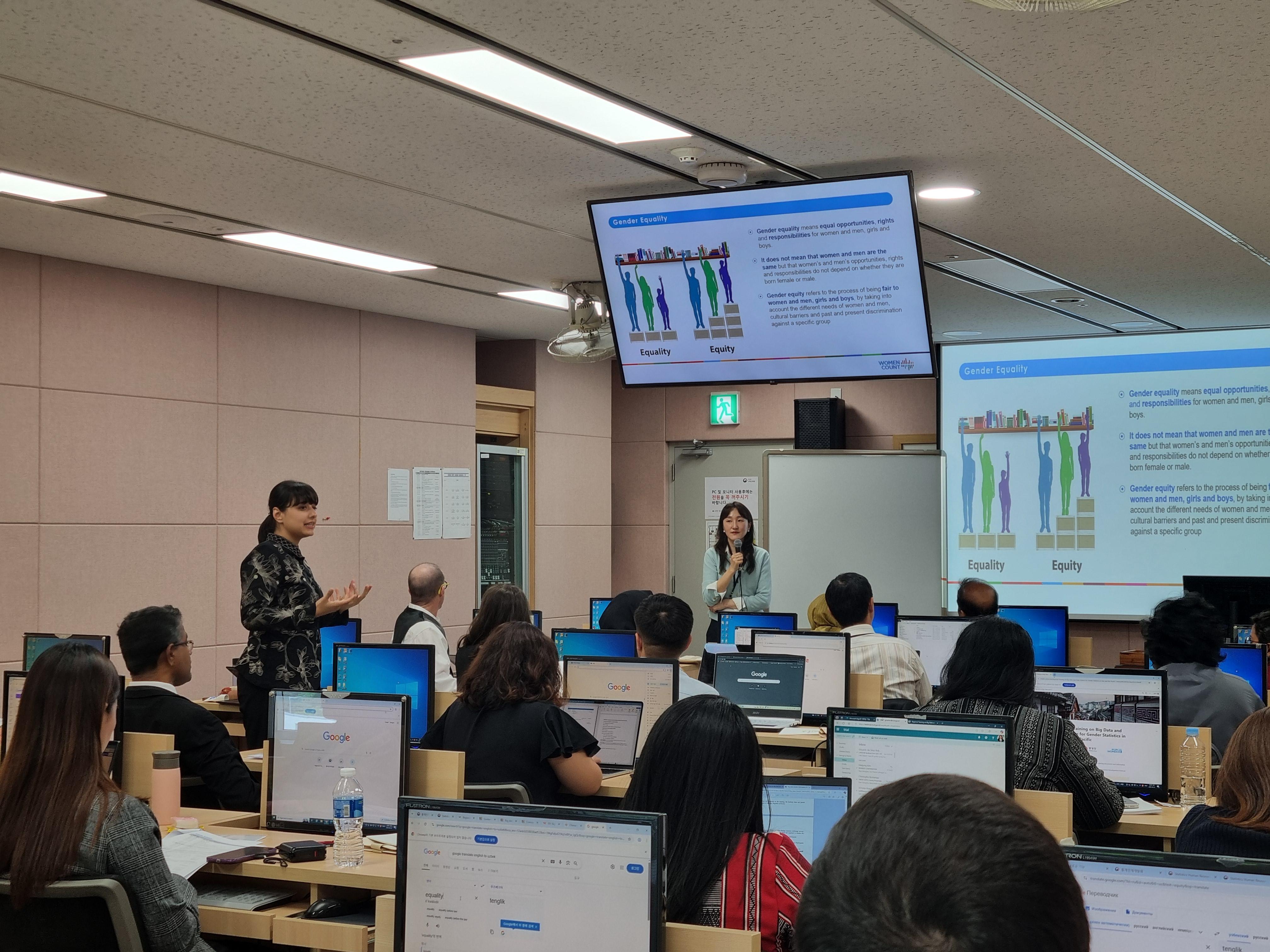
As Deputy Director of the Demography and Health Wing of the Bangladesh Bureau of Statistics (BBS), Asma Akhter regularly uses the pioneering Women Count Gender Statistics Training Curriculum to train staff.
“This has helped build their capacity to understand and apply gender data, strengthened their technical skills, and promoted the use of evidence-based approaches to address gender inequalities,” she says.
Post-training evaluations for 36 data producers and users trained using the curriculum in Bangladesh in 2025 showed an 84% improvement in their knowledge of gender statistics. According to one participant: “This training has equipped me with the knowledge to transform raw data into impactful reports, and I look forward to sharing these skills with my colleagues.”
In Indonesia, the national statistics office (BPS) used the curriculum at the end of 2024 to build the capacity of colleagues at the Ministry of Finance and Ministry of Planning. This sparked great interest in learning more about basic concepts and how to obtain and collect gender data to draft regulations related to the budget provided for gender in its regions, with participants even asking for a second session.
And in the Philippines, following a 4-day gender curriculum training in 2024, evaluations showed 98% of participants considered the training “very useful” or “quite useful” for their work. As one participant said: “the training motivated us to do research and analysis using gender data."
Meanwhile, in Mongolia, a mandatory gender statistics course largely based on the curriculum (specifically integrating modules 1, 2, 3, 6, 7 and 9) was included in an interdisciplinary Gender Studies graduate programme at the National University of Mongolia in 2024.
“We’re using the best of the best that the world has to offer us,” says Professor Otgontugs Banzragch, about the training curriculum. “We just needed to introduce it in the Mongolian language and make our future policymakers on gender and other areas understand that it’s important. We need them to know where to find and how to use gender data.”
She says it’s important for gender studies students to have a firm grounding in statistics so they can comprehensively anticipate, and address, future problems:
“If we don’t to instil that gender understanding in future policymakers, we will lose. They will only work with numbers. They will only see the trees, not the forest – the bigger problem,” she says. “Gender statistics is not only about numbers; it sometimes gives you very chilling insights about the future.”
In the Special Administrative Region of Hong Kong, former television journalist Rose Luqiu, PhD., and Associate Professor and Associate Head of the Department of Journalism at Hong Kong Baptist University (HKBU) has been an active member of the Subgroup on Gender Statistics Training within the Asia-Pacific Network of Statistical Training Institutes, which guided the development of the curriculum.
Drawing inspiration from the curriculum, Luqiu created and started teaching a new course for HKBU undergraduate students in entitled “Telling stories by using gender data” that integrated parts of at least four or five different modules of the training curriculum in the course, including on the basics of gender statistics, as well as finding, analysing and communicating gender data.
“Data journalism is trendy, so we get a lot of interest, especially from students from other faculties,” says Luqiu. “I used to think only female students would be interested, but we usually have about half-and-half gender balance.”
Luqiu’s course includes a final project to produce a longer (2,000-word) gender data story using at least one data set from government, as well as other data sources, in either English or Chinese languages. Some students have also used data-visualization techniques learned in the course, designing websites, producing videos or creating social media content, campaigns or infographics. Some students are also integrating what they’ve learned in their publications and public advocacy.
The curriculum was developed in 2018, and updated in 2024, by UN Women’s regional Women Count programme for Asia and the Pacific and the Statistical Institute for Asia and the Pacific (SIAP) under the guidance of the Subgroup on Gender Statistics Training within the Asia-Pacific Network of Statistical Training Institutes. The curriculum has built the capacities of data users and producers around the world through events and trainings in 82+ institutions across more than 30 countries, with more than 600 individuals taking self-paced e-learning modules.
According to Sinovia Moonie, a statistician and lecturer with SIAP who helped develop the curriculum, it has “enabled scalable, high-quality training across Asia and the Pacific, expanding reach through flexible delivery across face-to-face, online and hybrid modalities at national, subregional and regional levels. Beyond these outputs, it has driven institutional change by supporting the integration of standardized training approaches into national statistical systems, strengthening sustainable capacity, and promoting more consistent and rigorous production and use of gender statistics.”
The reach of this pioneering curriculum also now extends far beyond Asia and the Pacific, being adapted into multiple languages and locales, including to train governmental non-governmental officials and organizations in Albania, Bahrain, Brazil, Côte d’Ivoire, Dominican Republic, Germany, Kazakhstan, Kenya, Mexico, Senegal, Sudan, Tanzania and Uganda, with adapted regional curriculums developed in both East and Southern Africa as well as West and Central Africa.