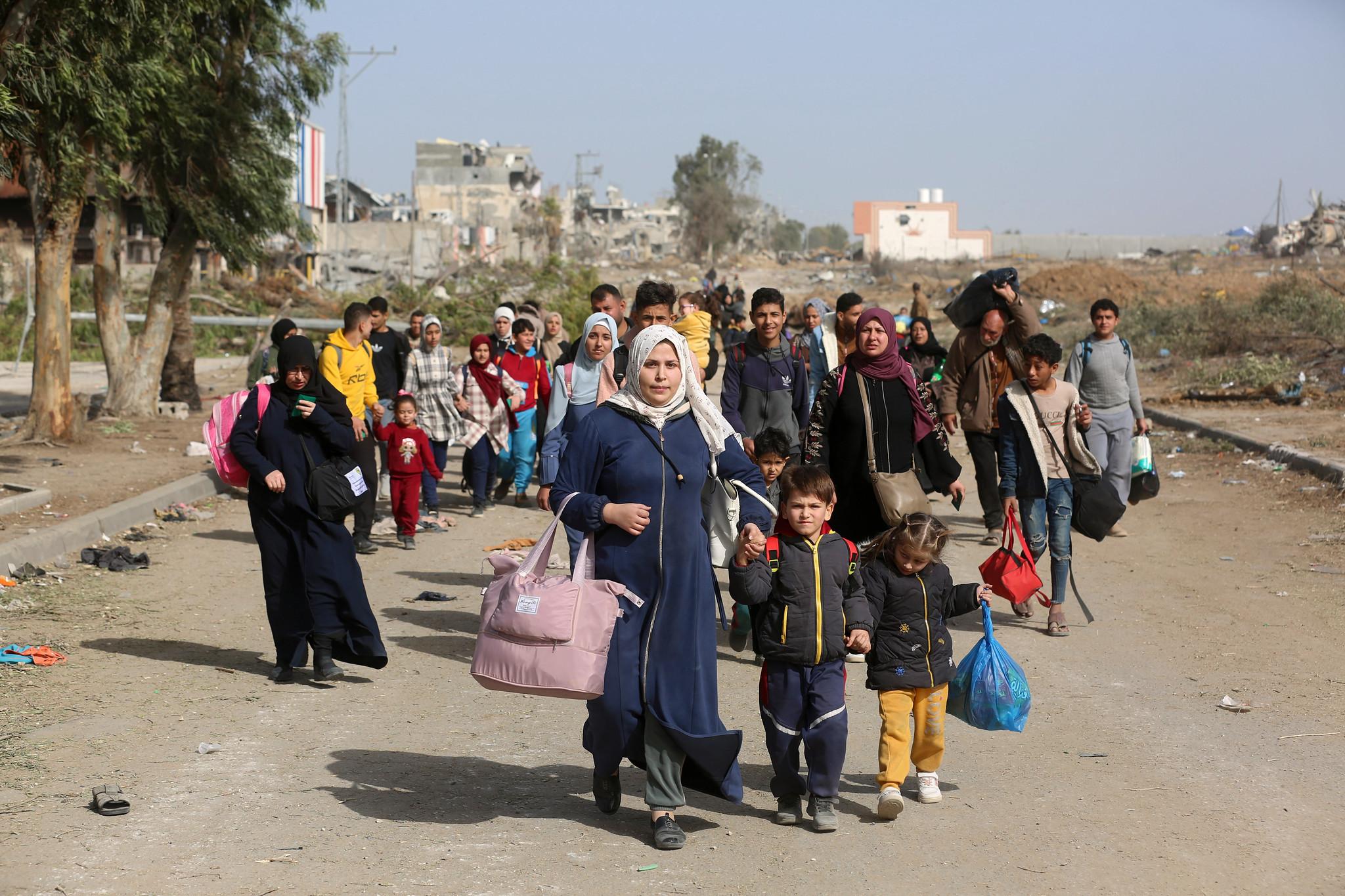
After the war destroyed the home that S.A.* and her family had worked for, displacement pushed her from Gaza City to Al-Shifa Hospital, then farther south. Her husband drifted away under the weight of debt and war, stopped supporting the family and eventually disappeared.
“I was in a very dark place – hunger, loss and confusion,” she recalls. “My children kept asking about their father, and I had no answers.”
Then came the shock that broke what was left of her stability. S.A. discovered that her husband had married another woman while their three children were hungry and displaced. When she sought separation and support, she was left without financial support and, for a time, without access to her children.
“I lost control of everything,” she says. “I felt lost and exhausted.”
The turning point came when she reached the Centre for Women’s Legal Research ,Consulting and Protection (CWLRCP) – a strategic local partner supported by UN Women as part of the humanitarian response. There, S.A. received psychosocial support, legal counselling and representation, and practical help to begin rebuilding her life.
She started divorce proceedings and saw her children again through the family visitation programme. She also received food assistance, hygiene supplies and a temporary work opportunity. Today, she describes herself as stronger and more able to stand for herself and her children.
In Gaza, the war has hit women like S.A. in ways that are often invisible, unless they are counted. One rapid gender assessment, five Gender Alerts and multiple press releases supported by UN Women have documented how displacement and family separation, food insecurity, lack of access to water and sanitation, disrupted health services, lack of privacy, and rising protection risks have been upending women’s lives and impacting local women’s organizations.
The Gender Snapshot for the Gaza Strip further revealed that 95% of businesses employing women had shut down; 1.1 million women and girls lacked access to clean water; 690,000 were living in overcrowded shelters; and 328,000 girls were out of school.
Such evidence has collectively informed UN Women's humanitarian response and improved targeting with partner women-led organizations (WLOs) already embedded in affected communities, for immediate response needs including legal aid, psychosocial services, safe spaces, disability-inclusive assistance and cash-for-work opportunities.
Between October 2023 and 31 December 2025, UN Women and partners reached nearly 196,000 individuals in Gaza with multi-sectoral protection information and services, emergency cash and livelihoods and essential non-food items. This includes at least 165,000 women and girls, and nearly 8,000 persons with disabilities.
For H.A., 34, dignity began with being able to see, hear and care again. Living in a worn tent in Al-Mawasi and separated from her husband, she was raising her 10-year-old child alone while facing severe health problems, including a brain tumour, vision loss, hearing loss and a chronic skin condition. At one point, she was collecting discarded vegetables from markets to survive.
Through UN Women partner WLO the Aisha Association for Woman and Child Protection, she received psychosocial assistance, medical referrals, assistive devices, emergency aid and cash support. The assistance helped her meet basic needs, access treatment and improve her daily functioning. Before receiving support, she says, her situation was so severe she considered ending her life.
“Now, I can say that Aisha changed something in me," says H.A. “I still suffer from many shortages, but I can take care of myself and my child better than before.”
UN Women support for organizations like CWLRCP and AISHA has also helped reopen shelters, safe spaces, access to psychosocial support, basic services and even Internet access, which has become a lifeline amid displacement. UN Women’s further analysis on the impact of recent funding cuts on WLOs/WROs and how it affects their capacity to lead and respond effectively has been guiding its advocacy for increased funding opportunities with key humanitarian and early recovery donors.
Cash-based support has helped displaced women like D.G.* who sought divorce after her husband physically assaulted her, and her young son tried to defend her. At the UN-Women-supported Women’s Affairs Centre, she joined psychosocial sessions, received legal support and later entered a cash-for-work programme.
“In one of the sessions, after all the confusion, came the awakening,” she says. “I am a strong person. I should not stop here. I was created to rise and continue.”
More than provide income, it restored her direction. D.G. first joined through the Sumud cash-for-work programme and later secured a longer-term role providing psychosocial support herself.
“Today I am providing a service that one day I needed,” she says. “I am very proud of myself.”
D.G. now sees her children again, can better protect their future and speaks about rights, safety and stability as things she is actively building. Her journey shows how cash assistance, when paired with psychosocial and legal support, can move a woman from survival to contribution.
UN Women’s recent report The Cost of the War in Gaza on Women and Girls, published in April 2026, estimates that more than 38,000 women and girls were killed in Gaza between 2023 and 2025 – an average of 47 per day – and highlights that nearly 11,000 women and girls have sustained injuries resulting in lifelong disabilities.
Across Gaza, gender data has helped reveal the scale and specificity of women’s needs, ensuring that support is better targeted, more responsive and grounded in women’s lived realities. For women like S.A., D.G. and H.A., this support has meant more than assistance. It has opened pathways to safety, dignity, recovery and renewed agency in the face of unimaginable loss.
*Names shortened for protection reasons.