When Zhaklin Lekatari, 43, was a child, she wished she had been born a boy. She learned early that being a girl meant fewer freedoms and greater expectations. “After a certain age, I had to protect myself,” she recalls.
Today, she is a journalist and feminist activist who speaks openly about women’s rights, their economic autonomy, sexual education and especially online violence.
“It’s a mix of misogyny, legal gaps, impunity and the algorithm,” says Lekatari.
But her engagement has come at a cost: harsh scrutiny, violent comments and frequent threats. Rather than allowing online abuse to stop her, she began documenting the hate.
“Naming the violence is the first act of resistance,” she says. “Transforming it into public dialogue is the second.”
Lekatari has been raising her voice as part of UN Women advocacy fuelled by data.
Data on online violence against women shape advocacy
A 2023 UN Women study supported by the regional Women Count programme found that 41% of Albanian women active online experienced digital violence and one in four women reported psychological harm resulting from online attacks.
These findings and others were highlighted in a nationwide campaign during the 2025 16 Days of Activism against Gender-Based Violence. Reaching more than 300,000 people and mobilizing influencers, institutions and private sector partners, the campaign delivered a clear message: abuse carried out through digital tools – whether via social media, messaging apps, or location tracking – is real violence, with lasting consequences for women’s safety, dignity and well-being.
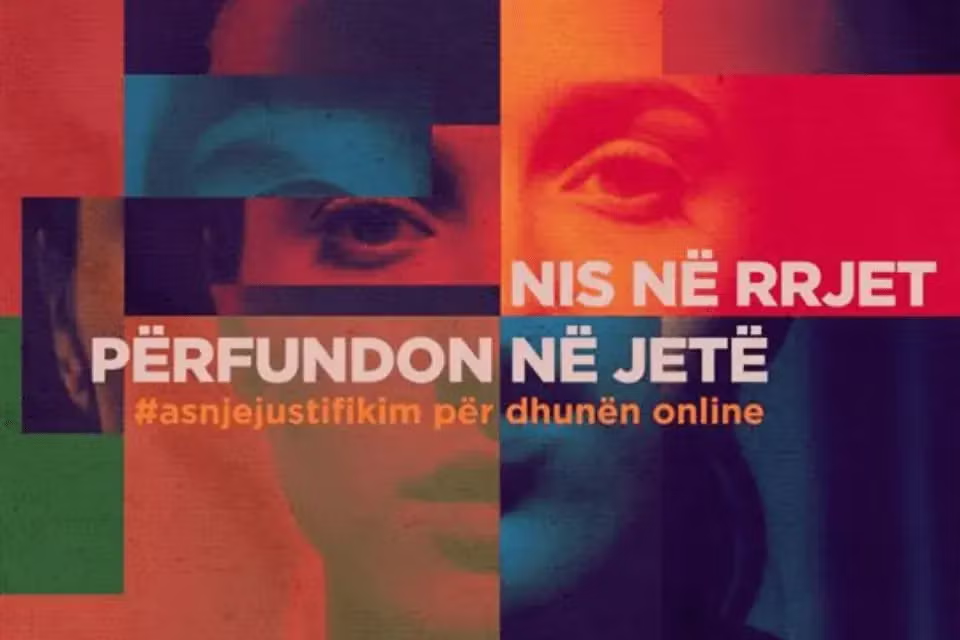
Poster used during the 16 Days of Activism campaign highlighting that online violence is real violence. Image: UN Women Albania.
Through clear visuals and simple language, UN Women Albania explained different forms of technology-facilitated abuse and why they should never be dismissed. Beyond statistics, the campaign emphasized how online abuse affects real lives, leading to anxiety, fear, self-censorship, and withdrawal from public and digital spaces.
“Online violence is real violence,” Lekatari emphasizes. “The scars may not be visible, but they stay in your voice, your silence, your fear of showing your face or using your real name.”
Police data show that 90% of perpetrators of online violence against women are men aged 15–44. More than half of the survivors are under 18. Stalking, extortion, bullying and hate speech are among the most frequently reported abuses to iSIGURT.al, the Albanian National Centre for Internet Safety. The platform analyses incidents in the online space, works with technology companies to remove harmful content, and alerts police when crimes are involved.
Yet many survivors, especially girls, hesitate to report. “They fear judgment, blame or social pressure,” says Ervina Gjana, Head of Cybercrime Investigation Directorate at the Albanian State Police.
Parents often underestimate the risks. “Many still do not understand how unsafe the digital world can be,” says Altin Hazizaj, Director of Child Rights Center in Albania, managing iSIGURT.al.
Catalysing legal change
Following years of UN Women data-sharing, advocacy and legal support, in January 2026, Albania adopted a new law on the “Prevention and Protection from VAW and Domestic Violence”, expanding the legal framework to address all forms of gender-based violence – including those occurring in public spaces, family relations, workplaces, politics and online. The law now formally recognizes digital violence strengthens access to legal and psychosocial support and establishes a clear mechanism for the rapid removal of abusive digital content.
“The adoption of the Law is grounded in robust evidence from prevalence surveys and administrative data, which show that violence remains widespread and often underreported,” says Etleva Sheshi, Director of the Department of Gender Equality at Albania’s Ministry of Health and Social Welfare. “This evidence has informed the development of a strengthened legal framework that addresses all forms of violence, improves access to services for survivors and reinforces prevention efforts.”
According to Iris Aliaj, a lawyer and UN Women expert who worked on the law, the new provides clear definitions of digital violence against women, and faster reporting and protection procedures.
The legislation defines threats, harassment, stalking and non-consensual image sharing as forms of violence. And when intimate photos, videos or personal information are shared without consent, State Police can take urgent action and guide survivors to safety.
These legal changes build on outcomes from Women Count phase I, including critical amendments to the Criminal Code that explicitly recognized psychological and dating violence and imposed stronger penalties on perpetrators, leveraging data from Albania’s 2018 national VAW survey.
For Lekatari, legal changes are only one part of the solution. “Platforms must take legal responsibility for the content they profit from. And the media must stop feeding the culture of digital violence or rage bait for sensationalism.”
Watch the campaign video