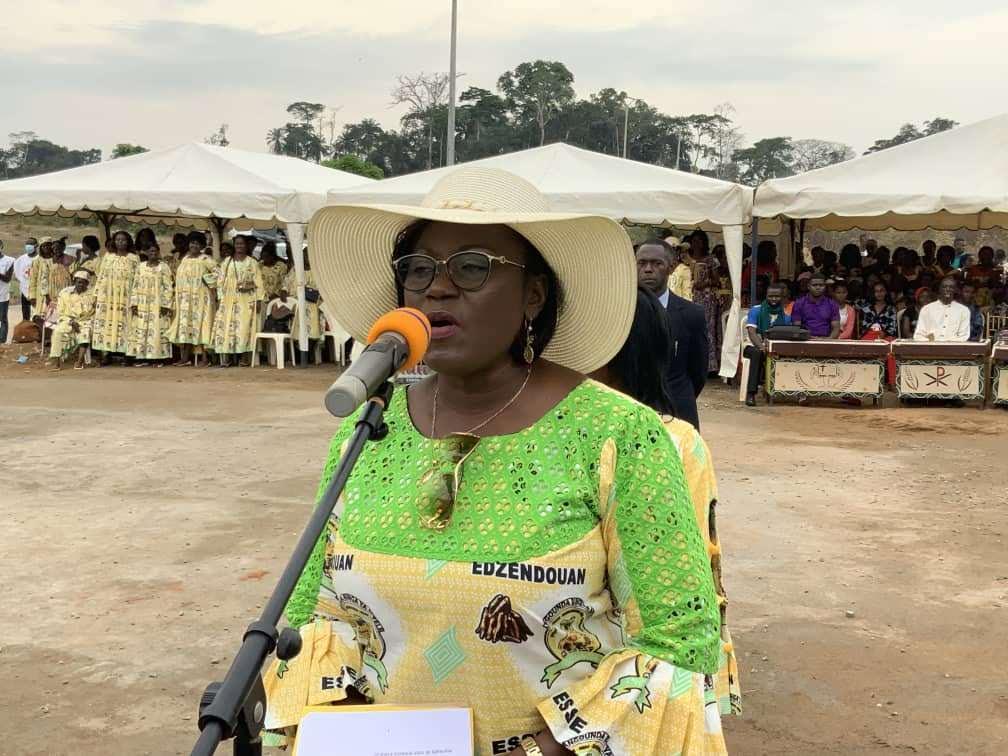
In 2014, when Marie Angèle Meyanga first ran for mayor in her commune of Afanloum, central Cameroon, she faced multiple challenges as the sole female candidate.
“Here, we have many cultural and linguistic barriers,” she explains. “I wasn’t accepted by the men or the elites because they had it in their minds that women can’t rule them, so women have to play second fiddle.”
But Meyanga proved everyone wrong, using her modest self-financing and respect within the community to win not only on her first attempt, but two consecutive terms.
It’s a battle she hopes will be easier for future local women politicians, thanks in part to new local governance strategy she says aims “to break down these barriers that weigh on Cameroonian women.”
Developed in 2023 by the Ministry of Decentralization and Local Development (MINDDEVEL) with UN Women support, the dedicated strategy is based on a diagnosis of the status of gender statistics at the local level, supported by the Women Count project in Cameroon.
The diagnosis found that only 24% of municipal councillors, 22.8% of regional councillors and 34% of mayors in Cameroon are women – an improvement, albeit still below regional and global averages. Further, it found that Cameroon has no women presidents of regional councils.
Addressing discrimination
To bridge these gaps, Lydie Ella Meye, Minister Plenipotentiary and Head of the Studies, Statistics, Planning and Cooperation Division of MINDDEVEL, says the Local Governance Strategy now includes an objective on fostering women’s leadership and political participation. It foresees actions ranging from capacity-building to gender mainstreaming in planning, budgeting and social services, to awareness-raising campaigns to confront obstacles such as harmful cultural practices.
“By strengthening the fight against discriminatory practices and gender-based violence, we can eliminate a number of brakes that prevent women from running for political office,” explains Meye. “It is only when we have worked on combating discrimination and marginalization in certain contexts that we can build female leadership.”
MINDDEVEL is working on implementing these activities with the Ministry for Women and Family and the Cameroonian Chapter of the Network of Locally Elected Women in Africa (REFELA-CAM), which is led by Meyanga.
This includes organizing a workshop for 30 would-be women leaders in July 2025, to improve their public speaking, networking and leadership skills ahead of the 2026 local and regional elections.
“We plan to gather women who want to run and share some of our experiences of how we got to this level. We’ll teach them the language of politics; the language of communication; how to get started,” explains Meyanga.
Encouraging signs
Meye says they’ve also already managed to get local authorities in charge of staff censuses to use a gender perspective and count how many women are in charge.
And although the Local Governance Strategy hasn’t been in place long, Meye says a recent assessment shows positive changes in the number of women accessing positions of responsibility in the past year. “From my perspective, this is a result of the Ministry’s strategy,” she says.
Another of the strategy’s objectives is equitable access to local public facilities, and the development of a local statistical information system envisaged to help monitor access to basic social services, by sex and other characteristics, such as disability.
“With Women Count … it’s really something we’ve capitalized on to go beyond simple statistics. To integrate this into various indicators, and in the work we do on gender-responsive budgeting,” adds Meye. “When we work at the local level, we pay particular attention to women, saying they can be doubly marginalized, as a woman and as a person with a disability, for example. This use of more disaggregated statistics and the Gender-Responsive Budgeting Strategy were also both introduced [in 2024].”
For her part, UN Women Representative in Cameroon, Marie-Pierre Raky Chaupin reaffirmed that decentralization is an essential framework for integrating gender equality issues into local policies and practices, and that the Local Governance Strategy is part of this dynamic.
“UN Women Cameroon strongly supports the initiative to promote local development that leaves no one behind,” she said. “We believe that this strategy, by systematically addressing gender equality within the framework of decentralization, will contribute to a more just, equitable, and prosperous future for all. We hope that this collective effort will promote informed decision-making and better consideration of the needs and aspirations of women and girls in local development.”