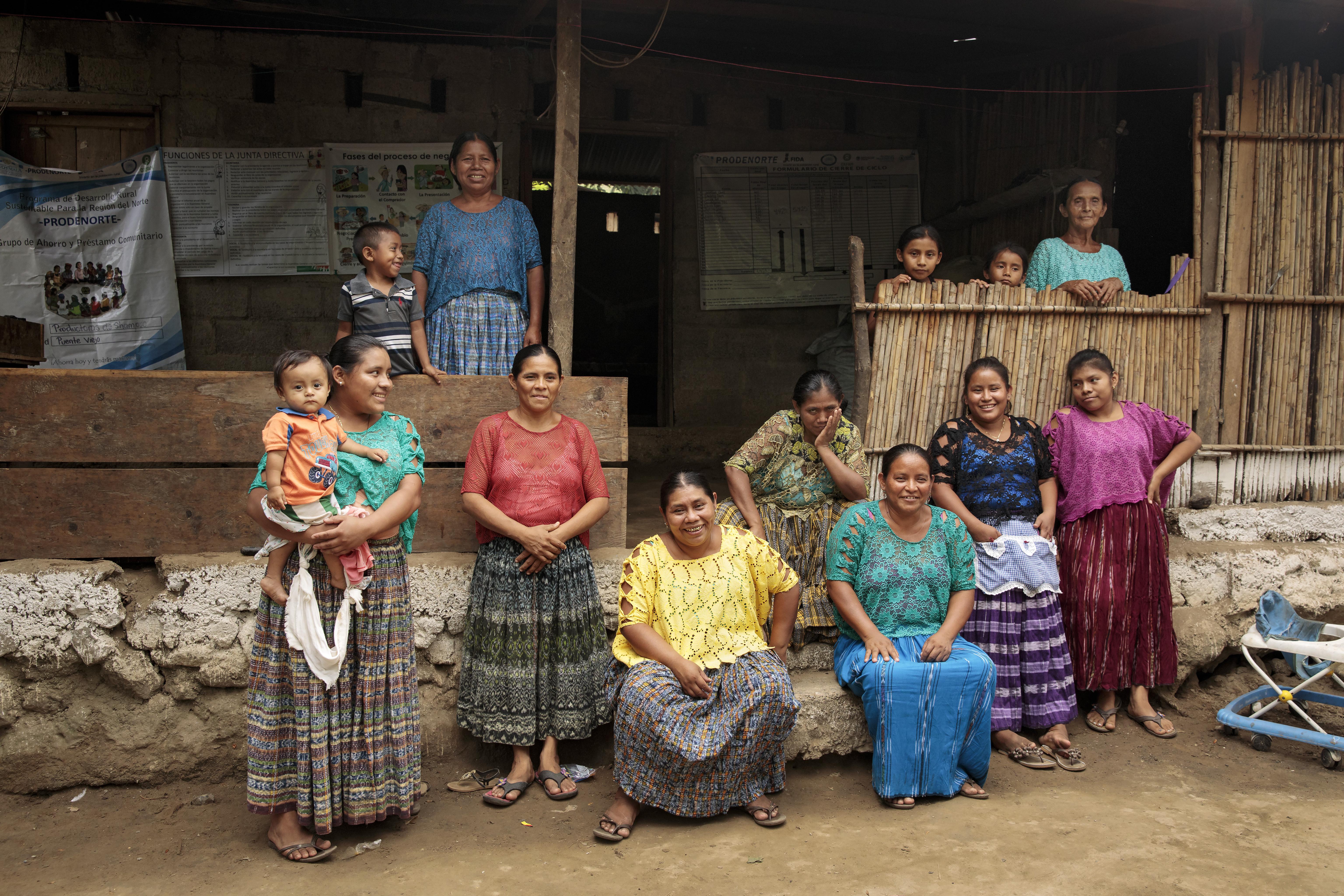
In Guatemala, persistent gender inequalities in both paid and unpaid work mean that women – particularly in rural and Indigenous communities – are more time-poor. This often overlaps with income poverty. These dual burdens are magnified by climate change, which increases care needs, disrupts livelihoods and leaves resources like access to water or fuelwood scarce.
Our analysis reveals that departments with greater deforestation have higher time and income poverty, with different effects on women and men.
The overlap between time poverty and income poverty is also greater among rural than urban and Indigenous compared to non-Indigenous populations. For example, time poverty in rural areas rose from 55.2% in 2000 to 57.9% by 2023 for women, and from 49.1% to 52.8% for men, while rates dropped for urban women and men over the same period. The combined intersection of time and income poverty rates are also sharpest in rural areas, particularly for women, affecting 36.1% of rural women versus 33.2% of rural men in 2023. Spanish speakers also had significantly lower time and income poverty rates than non-Spanish (generally Indigenous language) speakers.
Our analysis of Guatemala’s time-use surveys from 2000 to 2023, combined with spatial measures of deforestation and climate variability, ultimately demonstrates that environmental degradation and climate change multiply poverty, straining both time and income and eroding household resilience.
To make these results more visible, and translate data into policy action, we created an interactive dashboard. Users can explore indicators on time poverty, income poverty, agricultural labour, unpaid work and climate conditions side-by-side. By linking social and environmental information, the dashboard shows where climate pressures are greatest, which populations are most affected, and how vulnerabilities differ for men and women.
This kind of evidence needs to shape policymaking. We need to integrate time-use and care metrics into national poverty reduction and climate adaptation strategies. We also need more connected climate and poverty action, in Guatemala, and beyond.
Our recommendations? Make time poverty visible in national statistics and policymaking. Invest in climate-resilient infrastructure that reduces time burdens. Design green social protection programmes with time and care dimensions in mind. Ensure forestry and natural resource programmes include gender. Integrate care considerations in climate adaptation planning. Link climate finance to gender and time poverty outcomes. Promote regenerative agriculture and agroforestry with explicit gender targets. And strengthen local and Indigenous governance in climate action.
This can help ensure that climate action improves both human and environmental outcomes – and that poverty measures reach those most affected.
The findings presented here are drawn from research conducted by the authors and commissioned by UN Women for Progress of the World's Women 2027: Gender Equality in the Age of Climate Crisis. Further details on the methodology are available. A fuller discussion of the findings will be published in the forthcoming UN Women Discussion Paper “Invisible Burdens: Intersecting Gender, Time, Poverty and Climate Vulnerability in Guatemala.” For more information visit Progress of the World's Women.